Start with your plants and your route
Before comparing shapes, think about where you actually water. A few plants beside the sink call for something different from plants spread across several rooms. Notice whether pots sit on open tables, narrow windowsills, high shelves, or inside decorative covers. The harder a pot is to reach, the more useful a controlled pour becomes.
Picture the route from the tap to the last plant. A larger can may mean fewer refills, but it can also be awkward to carry around furniture. If your plants are scattered, a manageable can that you refill once may be more pleasant than a heavy one you have to steer carefully. Choose capacity for the trip you make most often, not for the maximum amount you could carry.
Check filling, carrying, and storage as one task
The filling opening needs to work with your tap. A wide opening makes it easier to aim the water and see the level, while a narrow neck may be difficult to position beneath a low faucet. Consider whether you can set the can steadily in the sink while it fills. If you expect to use a jug to fill it instead, make sure the opening gives you enough room to pour without splashing.
Handle comfort matters most when the can is full. Look for a shape that lets you grip it without bending your wrist sharply, and check that your hand has room around the handle. A second grip point can help with a larger can, but it is not essential for a small one. Finally, measure the shelf or cupboard where the can will live, including the reach of its spout. An attractive can is less convenient if it has no easy place to go between uses.
Match the spout to the pots
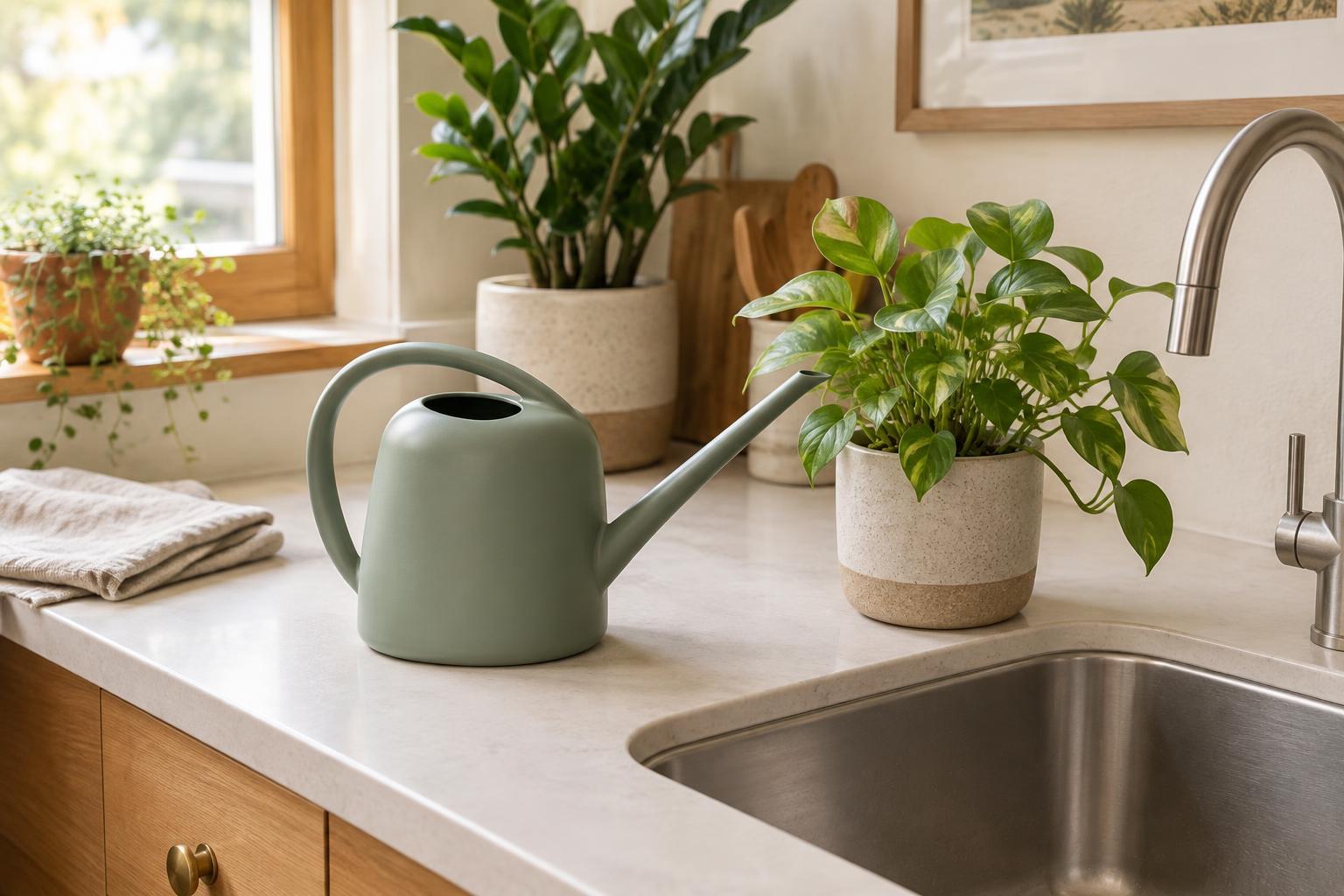
A long, narrow spout helps you direct water toward the soil of a crowded or recessed pot. It can be especially useful when leaves cover the surface or a pot sits inside a larger planter. Length alone is not the goal, though: an overly long spout can bump into shelves, and a very small outlet may make filling a large pot feel slow.
For open, easy-to-reach pots, a shorter spout may be simpler to handle and store. If possible, look closely at how the spout joins the body and whether its opening appears smooth and unobstructed. Whatever style you choose, pour slowly at first to learn how quickly water starts and stops. Even a precise spout can drip after you tilt the can upright, so leave a moment over the pot before moving away.
Choose materials you can maintain
Plastic cans are often light and easy to lift, although their surfaces may show scuffs over time. Metal cans can feel sturdy, but their weight and finish vary; check care instructions if you expect to leave water standing in one. Ceramic cans may suit a visible shelf, yet their weight and breakability can make them less practical for a long watering route. The best material is one you can comfortably carry and clean.
Simple construction is usually easier to maintain. Look for an opening that lets you empty the can completely and reach inside for a rinse. If the spout is very narrow, letting the can drain and dry after use can help prevent residue from accumulating where it is hard to reach. Check that seams, edges, and the handle feel secure before buying, especially if you plan to fill the can near its stated capacity.
Make the choice fit your household
If more than one person waters the plants, agree on where the can will be kept and which pots are difficult to reach. The person with the smallest comfortable grip or the longest watering route may reveal a limitation that is easy to miss when shopping alone. A quick trial with an empty can can help you judge its balance and whether the spout clears your shelves.
If you enjoy a more structured approach to household choices, browse Survey Design · Market Insight Notebook for ways to think about the questions you ask. For a household with different watering routines, Audience Segmentation · Market Insight Notebook is another place to explore how to group preferences rather than assuming everyone needs the same thing. You can also browse Customer Interviews · Market Insight Notebook if you want ideas for talking through small frustrations before replacing an object. Keep the final decision simple: the right can is the one you can fill, carry, pour from, clean, and put away without making a routine task harder.