Start with a relaxed fit
A good pair of sunglasses feels steady rather than tight. Put them on with both hands, then let your face relax. The frame should sit level, with the lenses comfortably in front of your eyes and the bridge resting on your nose. You should not need to scrunch your nose, raise your eyebrows or push the frame into place to make it feel secure.
Give yourself a minute before deciding. A frame that seems fine for a few seconds may begin to press behind your ears or slide down as you talk. Notice where it touches your face: the bridge, the sides of your head and the parts of the arms that rest over your ears. Even contact is a better sign than one spot doing all the work.
Check the bridge for sliding and pressure
The bridge helps determine where the sunglasses sit. If the frame repeatedly travels down your nose, the bridge may not suit its shape or the frame may be too wide. If it presses sharply into one small area, it may be too narrow or sitting at an awkward angle. Look for a stable position that does not depend on pushing the sunglasses high up your nose.
Try looking down at a table, then return your head to a normal position. The sunglasses may shift a little, but they should not drop noticeably or demand an immediate adjustment. If the pair has adjustable nose pads, check that both pads make comfortable contact. Pad position can sometimes be changed, while a molded plastic bridge offers less room for adjustment.
Feel along the sides and behind your ears
The arms, also called temples, should hold the frame in place without squeezing your head. If you feel firm pressure at your temples, a headache-like tightness or discomfort behind your ears, do not assume the frame will become comfortable simply because you like its shape. At the other extreme, arms that barely touch may let the sunglasses slip whenever you move.
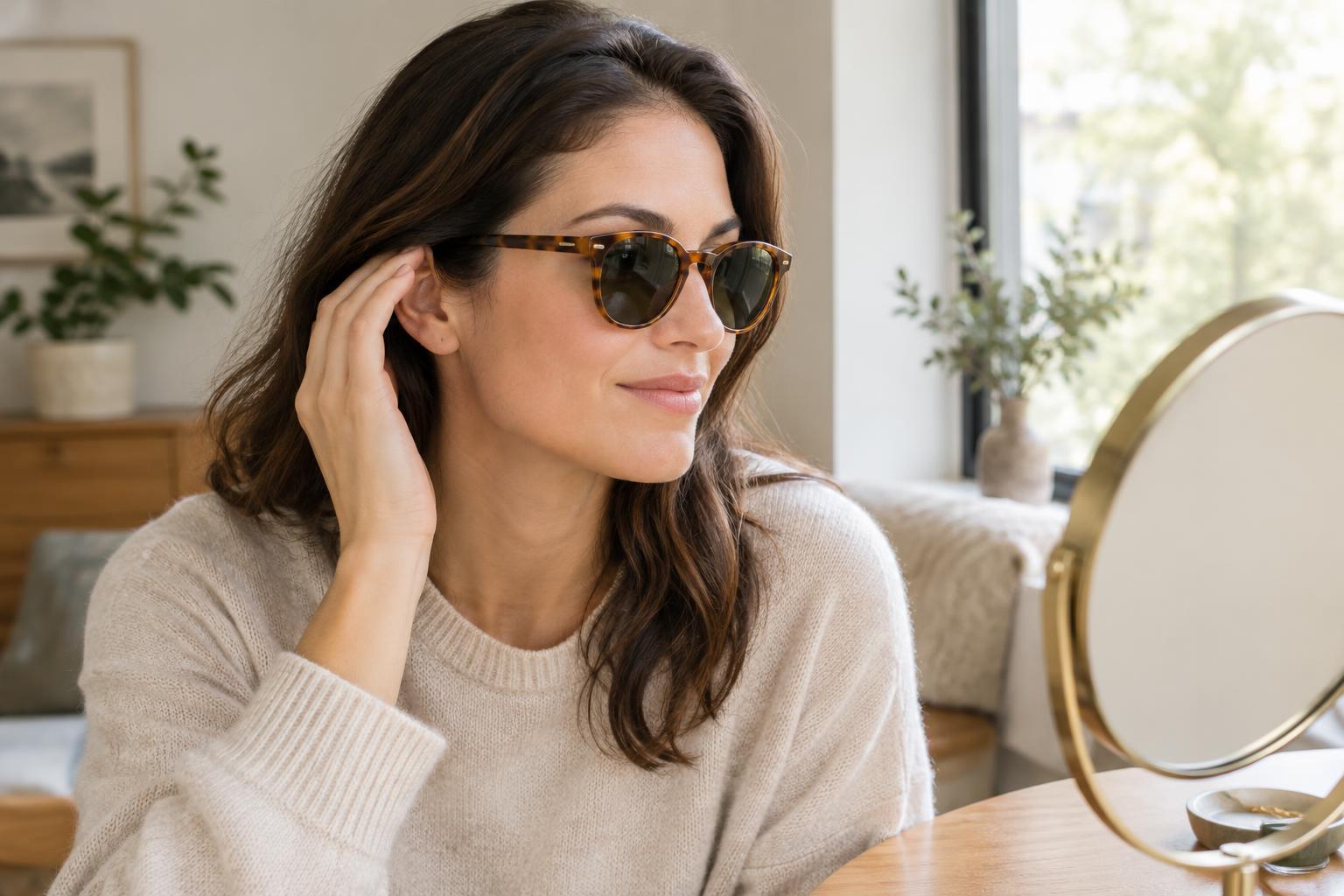
Open and close your mouth a few times, smile and turn your head from side to side. These small movements reveal whether the frame stays balanced in ordinary use. Check in a mirror that the arms do not bow outward dramatically and that the front of the frame is not pulled against your cheeks. Fit can change when you look down or smile, so test more than one expression.
Use a short movement test
Walk around for a minute if you can. Look down as though checking a bag, turn as though greeting someone and gently shake your head once. The aim is not to make the sunglasses immovable; it is to see whether they stay comfortably positioned through the movements you actually make. A pair that works only while you stand perfectly still may become annoying on a relaxed day out.
Pay attention to your eyelashes and cheeks, too. Lenses that brush your lashes or a frame that bumps your cheeks when you smile can distract you even if the arms feel right. If you wear the sunglasses with a hat, try them together. A brim or snug hat can change how the arms sit, and it is easier to notice that before you commit to the pair.
Decide what can be adjusted—and what cannot
Small fitting changes may help with a promising pair. Depending on the frame, an optical shop may be able to adjust the arms or nose pads. That is different from trying to fix a frame that is fundamentally too wide, too narrow or poorly shaped for your nose. If several contact points feel wrong, another frame is usually a simpler choice.
When shopping online, compare the listed frame width, bridge width and arm length with sunglasses you already find comfortable, if you have them. Those measurements are useful starting points, not a guarantee: two frames with similar numbers can fit differently because of their shape and materials. Check the return policy before ordering so you can try the sunglasses calmly at home. Once they arrive, repeat the bridge, side-pressure and movement checks rather than judging fit from a mirror alone. Comfort and stability are separate from lens protection, so check the product’s stated UV protection as well.