Start with what you reach for
Before looking at styles, list what you actually use beside the bed. A lamp, water glass, book, phone, and glasses may all need a place, but not everything needs to stay in view. Keep daily essentials on the surface and give occasional items a drawer or shelf. This distinction helps you choose a table for your routine rather than one that merely looks tidy in a photo.
Notice which side of the bed you use and how you reach when lying down. If you tend to set down a book without sitting up, an open patch of tabletop matters more than a large drawer. If you prefer a clear surface, enclosed storage may be worth prioritizing. For a shared bed, each person may need a different solution; matching finishes can create a sense of order even when the tables have different layouts.
Get the height and reach right
Compare the tabletop with the top of your mattress as it sits on the bed frame. A surface near mattress height is often comfortable to reach from bed. A much lower table can make you stretch for a glass, while a much higher one may feel awkward when putting things down. Your mattress, pillows, and usual sleeping position affect the best fit, so treat this as a starting point rather than a fixed rule.
If possible, test the reach from your normal position with a similarly sized object beside the bed. Check whether you can grasp a glass easily and see the tabletop without leaning over an edge. Think about the lamp, too: its base will occupy space, and its switch should be convenient to use. Measure with the lamp in mind, not just the empty table.
Choose storage you will actually use
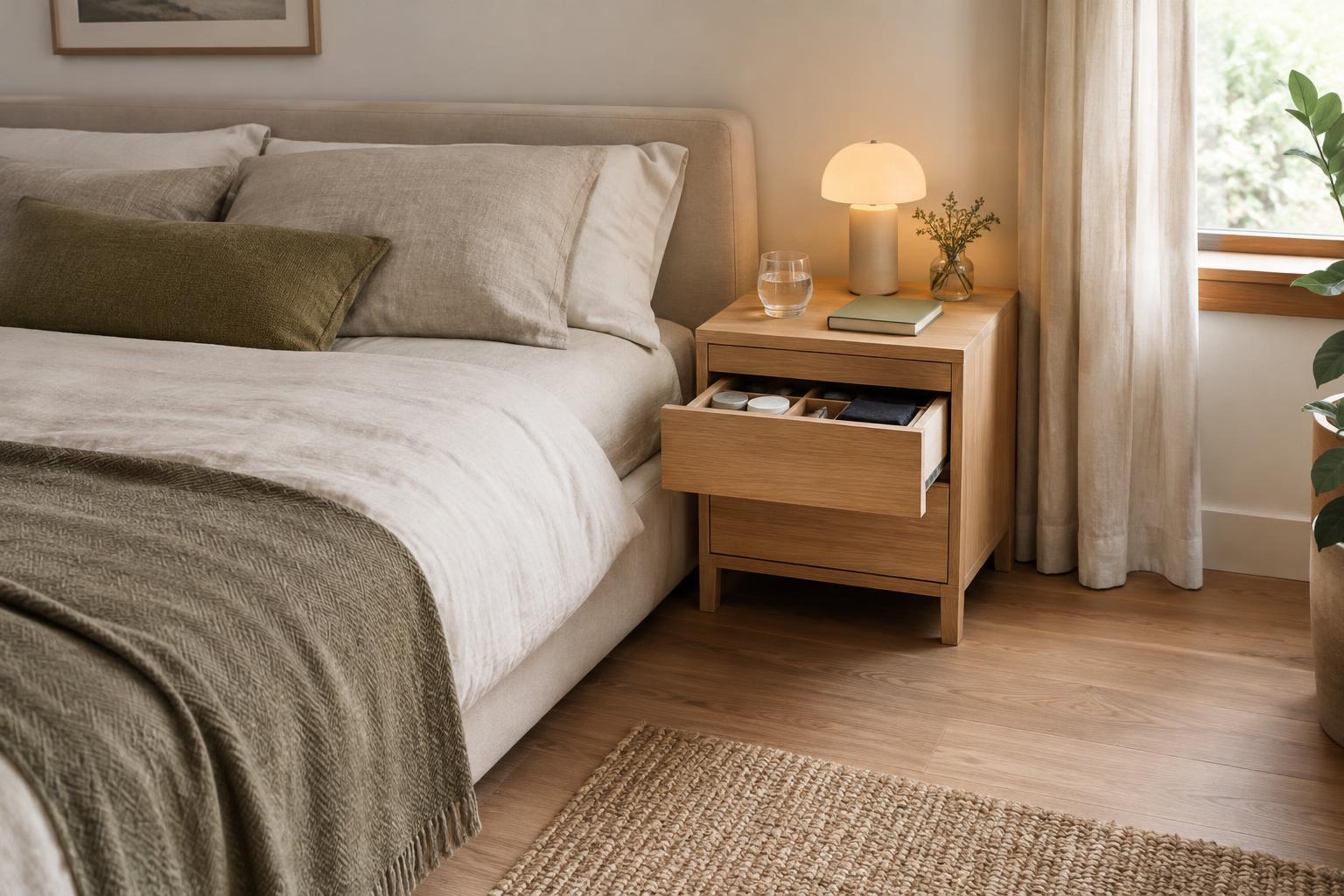
A drawer keeps small items out of sight and can make the bedside area feel calmer. Check that it opens smoothly with one hand and that its handle is easy to find in low light. A deep drawer is not automatically better: if everything settles at the back, a shallow drawer or a simple divider may serve you better. Look at the inside dimensions, not only the table’s overall size.
An open shelf works well for books, a small basket, or items you want to spot quickly. It also leaves its contents visible, so consider whether that suits the room. A cabinet can conceal bulkier items, but its door needs room to swing. If you rarely store anything beside the bed, a compact table with no storage may give you all the function you need while taking up less visual space.
Measure the space around the table
Measure the gap between the bed and any wall, wardrobe, or doorway before choosing a width. Then check what happens when a drawer is fully open or a cabinet door swings out. You should be able to move past the bed comfortably and use nearby furniture without shifting the table. A narrow room may benefit from a slim table with vertical storage, while a roomy corner can accommodate a broader surface.
Pay attention to where the legs or base sit. A table with a wide top but a compact base can offer useful surface area without looking heavy, provided it remains stable. If you have a rug, check whether the table will stand evenly on it. Also plan a route for a lamp cord or charging cable so it does not trail across a walking path or get caught in a drawer.
Finish with durability and a simple layout
Bedside tables handle water glasses, books, hand creams, and repeated wiping. Choose a surface you are willing to care for, and consider a coaster or small tray where spills are likely. Look for steady construction, drawers that align well, and edges that feel comfortable to touch. If the table is light or narrow, check its stability with the items you expect to put on it.
Finally, picture the tabletop in use: lamp at the back, frequently reached items toward the bed, and a little clear space for putting something down. A bedside table does not need to hold your whole evening routine. The right one makes the essentials easy to find, leaves room to move, and feels natural to use when you are ready to rest.