Start with what you actually carry
A coin pouch is most useful when it solves a specific small-item problem. Empty your pockets or bag onto a table and look at what tends to gather there: coins, shopping-cart tokens, a spare key, earbuds, or folded receipts. Decide which of those items belong together. A pouch that holds everything may sound convenient, but mixing sharp keys with delicate earbuds can make both harder to find and may cause wear.
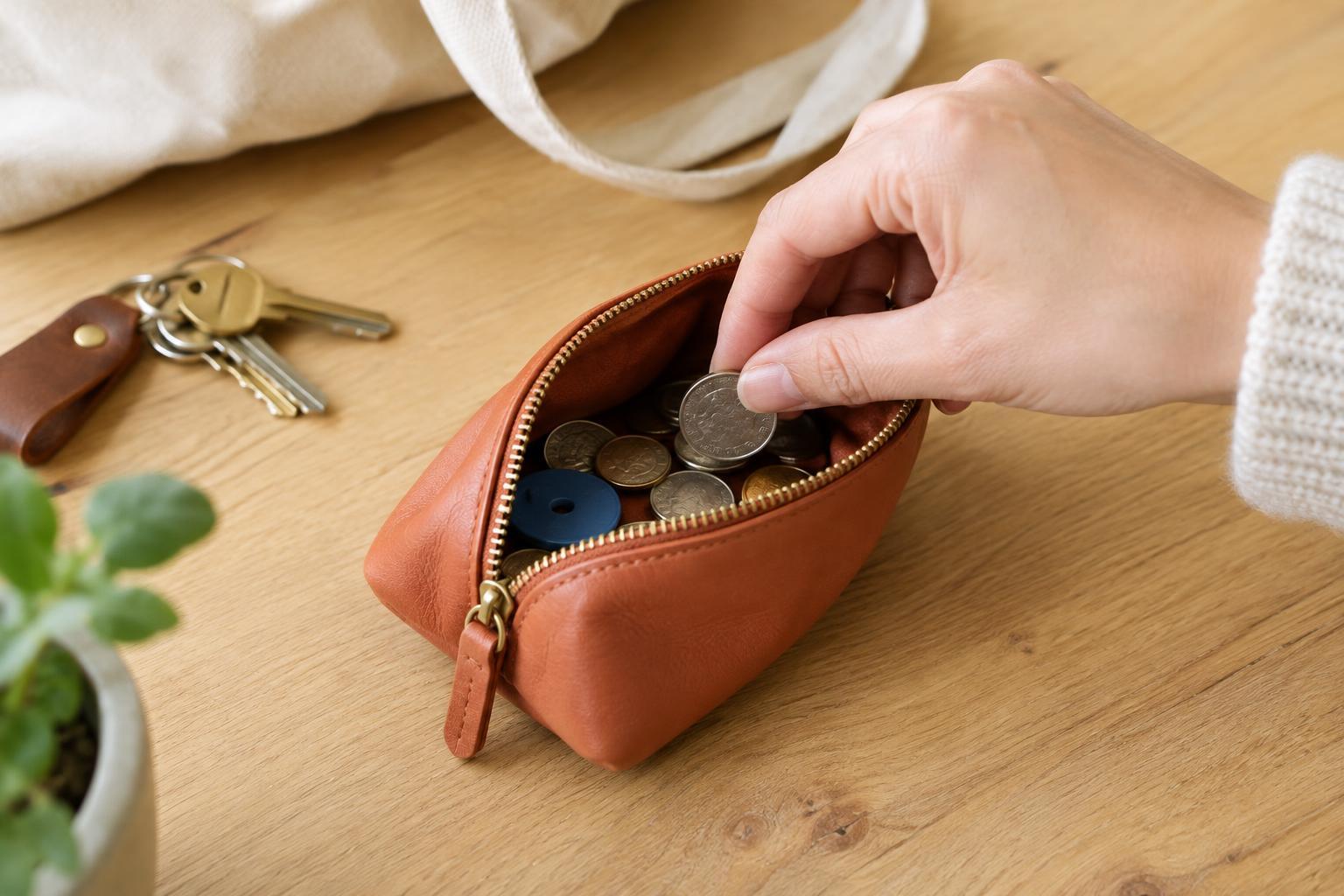
Think about when you reach for the pouch. If you regularly use cash at a counter, you’ll want to see and retrieve coins without pouring out the contents. If it mostly holds an emergency token or spare change, a slimmer pouch may be enough. You can test the size you need by grouping your usual contents in your hand before comparing them with a pouch’s stated dimensions.
Choose a shape that gives your fingers room
Flat zip pouches take up little space in a pocket or narrow bag compartment, but tightly packed coins can be awkward to pick out. A pouch with a gusseted base opens into a wider space and may stand up while you search. A rounded pouch can be comfortable to hold, though it may use more room than its contents require. Consider the space where you’ll carry it, not just how it looks on a shelf.
Check the opening as carefully as the overall size. Can you spread it far enough to see the bottom? Can you reach in without scraping your knuckles against the closure? If you use the pouch while standing or holding another bag, a wider opening may be worth a little extra bulk. For an online purchase, compare the opening and depth measurements with a pouch you already own, if you have one.
Match the closure and material to the job
A zipper is a straightforward choice when the pouch will move around inside a bag. Look for a pull you can grasp easily and a zipper path that doesn’t leave a narrow opening. Snaps and clasp frames can be quicker to open, but check whether they close securely when the pouch is full. Drawstrings offer flexibility for bulkier contents, although they may be less tidy for loose coins you access often.
Material changes how the pouch feels in use. Soft fabric can fold around a small number of items, while a firmer material helps the pouch keep its shape. A wipeable lining is handy if you expect to carry coins or tokens that leave residue. Pay attention to stitching at the corners and around the closure, where repeated opening and a little extra weight can put stress on the pouch.
If the pouch will carry a keepsake coin as well as everyday change, consider giving that coin its own sleeve or compartment to reduce rubbing. For further browsing about coins beyond everyday change, explore Coin Collecting Basics · The Coin Collector's Desk.
Make it easy to keep using
The best place for a coin pouch is one you can reach without unpacking your whole bag. Try an outer pocket for frequent purchases or an inner pocket for items you use less often. A wrist loop or small attachment point can help you retrieve the pouch, but check that it won’t catch on other belongings. Avoid attaching a heavy pouch somewhere it swings or gets in your way.
Give the pouch a simple rule: coins and tokens only, or coins plus one spare key, for example. Empty receipts and unfamiliar odds and ends when you get home. That small reset keeps the opening clear and makes it easier to notice when change has built up. If sorting through coins becomes an interest of its own, The Coin Collector's Desk is another place to browse coin-related topics.
Before buying, picture one ordinary moment when you’ll use the pouch. Can you find it, open it, select what you need, and put it away comfortably? A modest pouch that passes that test is likely to be more useful than a larger one chosen for features you rarely need.