Start with where you will wear it
The best hat for a short walk to a café may not be the one you want for a long afternoon outdoors. Before considering colors or styles, picture your usual setting. Will you be sitting in one place, walking in wind, carrying a bag, or moving between sun and shade? A hat that looks appealing but needs constant adjustment is unlikely to earn a regular place in your routine.
Decide which areas you want the brim to shade. A baseball cap can be convenient for shading your face, but it leaves your ears and much of your neck uncovered. A brim that runs all the way around offers more coverage, though its actual shade depends on its width, angle and the position of the sun. If you want a hat for both errands and slower outdoor days, choose for the longer outing; you can always wear it for a shorter one.
Check the fit before judging the style
To estimate your size, wrap a flexible tape around your head where the hat’s inner band will sit, usually above the eyebrows and ears. Keep the tape level and comfortably snug rather than pulling it tight. Compare that measurement with the maker’s size guide, since labels such as small and medium are not universal. If you are between sizes, an adjustable inner band can give you more room to fine-tune the fit.
When you try a hat on, place it where you would naturally wear it and keep it there for several minutes. It should rest securely without pressing on your forehead or temples. Gently turn your head, look down and walk a few steps. If it slides into your eyes, it may be too loose, too deep, or poorly balanced for you. If it rises off your head, the crown may be too shallow. A good fit is more than a circumference measurement: crown depth and shape matter too.
Compare the brim’s shade in real light
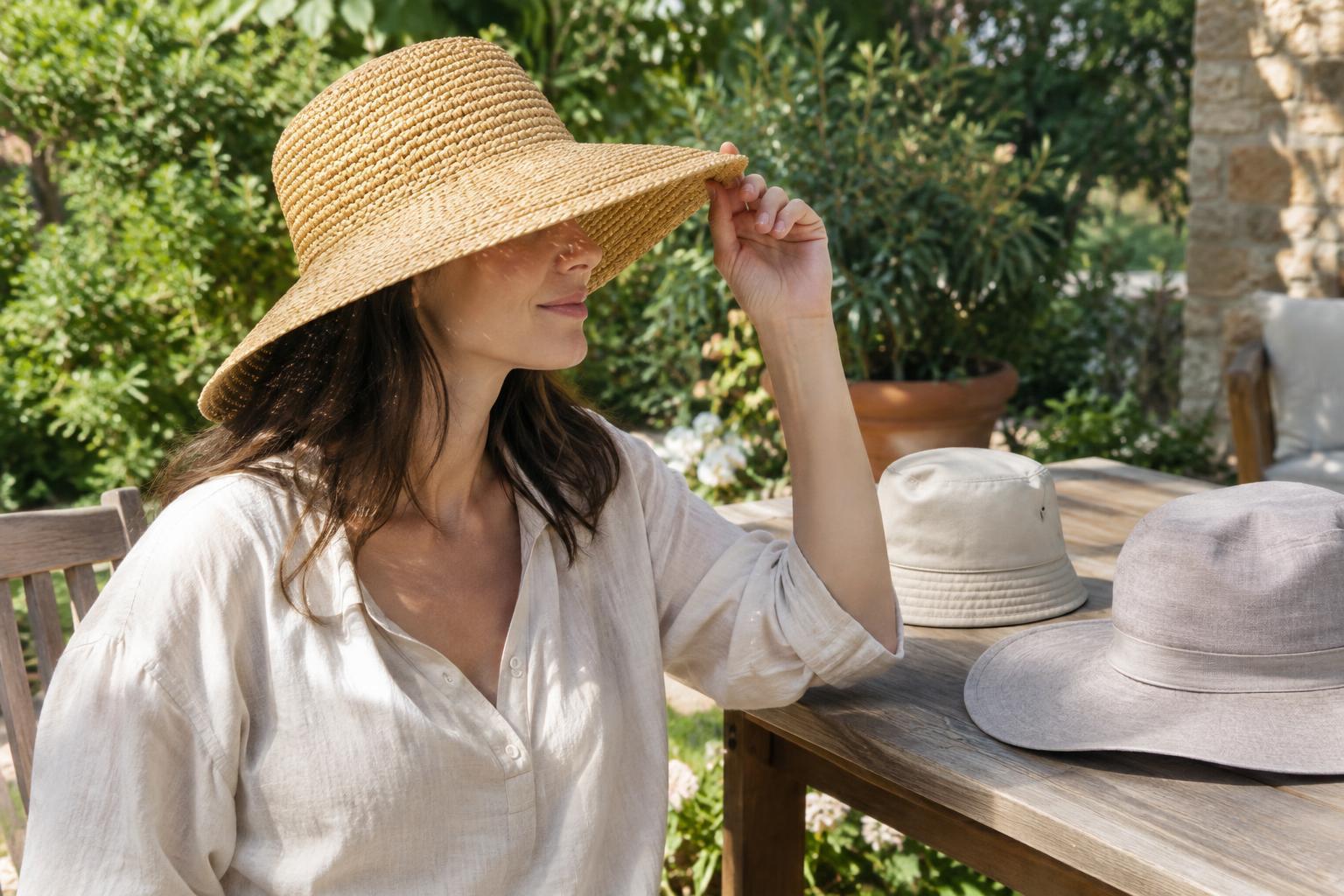
Brim width is a useful starting point, not a complete answer. A narrow, upward-curving brim may feel unobtrusive but cast little shade over the sides of your face. A wider, downward-angled brim can shade more area, although a very floppy one may fold back in a breeze or fall into your line of sight. Look at the hat from the front and side to see where the brim sits in relation to your face, ears and neck.
If possible, try the hat near a window or outdoors rather than relying on a mirror under overhead lighting. Notice the shadow it creates when you face the light and when you turn sideways. No brim provides the same coverage at every sun angle, and a hat does not replace other sun-protection measures for exposed skin. The aim is to find a shape that provides useful shade without making it difficult to see, talk or move comfortably.
Choose materials for your routine
Think about how the hat will feel after an hour, not just how it looks for a minute. A breathable fabric and a comfortable inner band can make warm-weather wear more pleasant. Tightly constructed fabric is generally a better choice when shade and coverage matter than a visibly open weave, which lets light through its gaps. If a hat carries a sun-protection rating, check what part of the hat the rating applies to rather than assuming it covers every exposed area.
Material also affects upkeep. A structured hat may hold its shape well but be awkward to pack. A crushable design is easier to carry, provided the brim springs back into a useful shape. Check the care label before buying, especially if the hat is likely to encounter sweat, rain or food spills. A color you enjoy wearing and can maintain easily may be a better everyday choice than one that feels too precious to use.
Make the final decision with a wear test
Small details can settle a choice between two otherwise suitable hats. An adjustable band helps accommodate different hairstyles. A chin cord may keep a broad brim secure in a breeze, but it should be easy to move out of the way when you do not need it. If you wear glasses, test whether the brim or band interferes with the frames. If you carry the hat, consider whether it can hang from your bag or fit inside it without damage.
Before buying, ask three questions: Does it stay put without pressure? Does the brim shade the areas I intended? Will I be willing to wear and care for it on an ordinary day? If the answer to any of these is no, try another crown shape or brim rather than settling for a better-looking version of the wrong hat. The most useful choice is the one that fits your head, your plans and your habits.