Start with your wrist, not a size chart
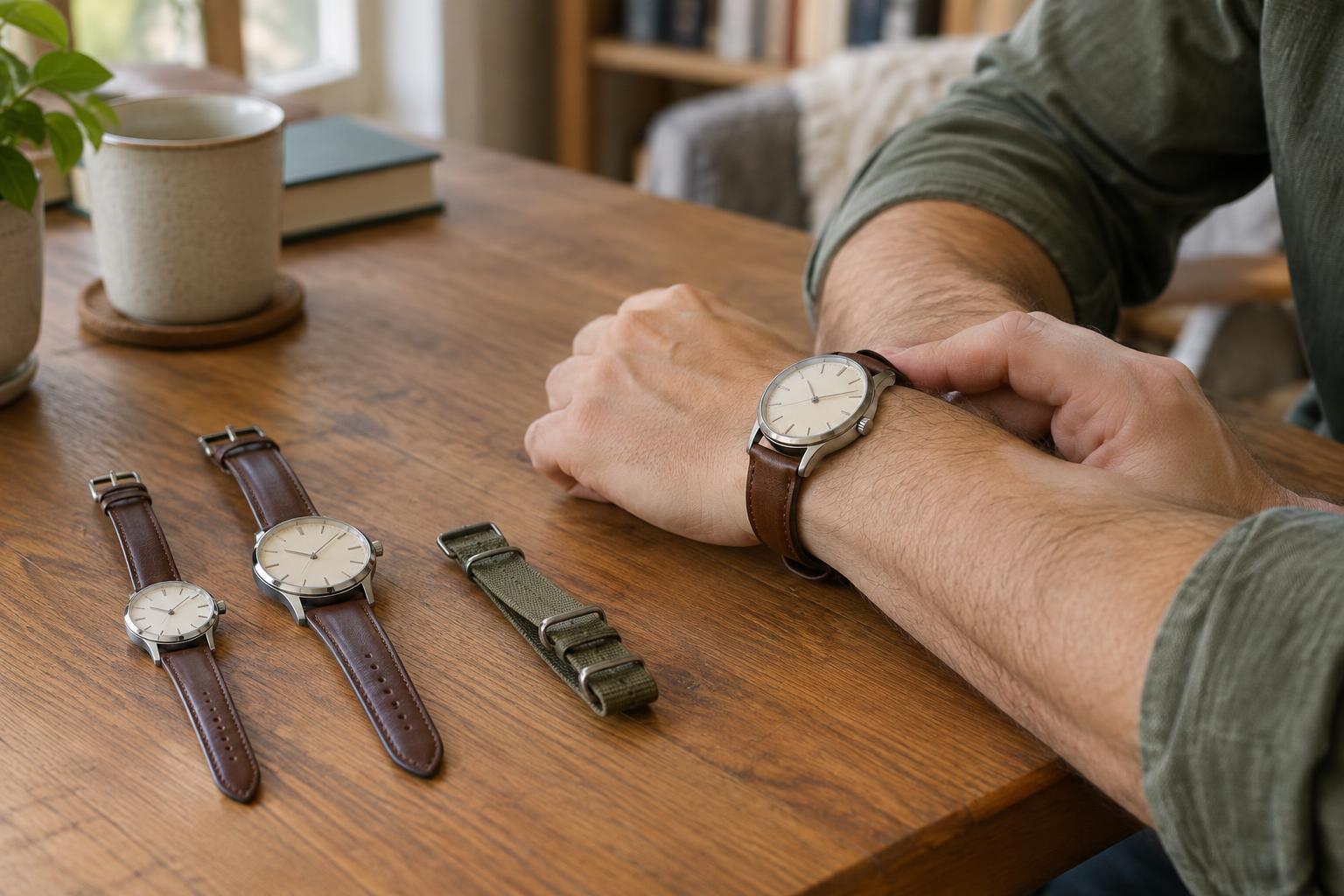
The most useful watch size is the one that feels comfortable and looks balanced to you. Wrist circumference can provide a starting point, but it cannot tell the whole story. Two wrists with the same circumference may have different shapes: one may be relatively flat across the top, while another is more rounded. A watch that sits neatly on the first may extend awkwardly over the sides of the second.
If you want a reference for shopping, wrap a flexible measuring tape around the spot where you normally wear a watch. Keep it comfortably snug rather than tight. You can also measure the width of the flat area on top of your wrist with a ruler. These measurements are useful for comparing options, not for assigning yourself to a strict “small” or “large” category. Your preferred look matters too: some people like a compact watch that blends into an outfit; others want the case to be more prominent.
Read case diameter alongside lug-to-lug length
Case diameter is usually the first number shown in a watch listing. It describes the width of the main case, generally excluding the crown, the small knob used to set the watch. Diameter helps you compare watches, but it does not reliably predict how far one will reach across your wrist.
For that, look for the lug-to-lug measurement: the distance from the tip of the upper lug to the tip of the lower lug. Lugs are the projections that attach the strap or bracelet to the case. As a practical check, the lugs should rest on top of your wrist rather than overhang its edges. A watch with a moderate diameter and long, straight lugs may wear larger than a wider case with short lugs that curve downward.
Listings do not always include lug-to-lug length. If you cannot find it, inspect side and wrist photos when available, or try the watch on before deciding. Compare the full outline of the watch against your wrist, not just the round part of its case.
Notice thickness and visual weight
Case thickness changes both comfort and appearance. A thick watch may stand noticeably above the wrist, catch on a sleeve or feel top-heavy, even when its diameter seems right. A thinner case often slips under a cuff more easily. If you regularly wear fitted sleeves, consider that part of the fit test rather than an afterthought.
Design details can make watches with similar measurements appear different in size. A wide bezel frames a smaller-looking dial, while a narrow bezel gives the dial more visual space. Bright dials, bold numerals and broad straps can make a watch feel more assertive. Dark colors and simpler details may make it seem quieter. None of these effects is a rule for what you should wear; they explain why measurements alone cannot choose for you.
Give the strap or bracelet a fair test
A good case fit can be undermined by a poor strap fit. Check that the watch sits reasonably centered and does not slide to the side whenever you lower your arm. You should be able to move your hand freely without the case pressing uncomfortably against it. The right amount of slack varies by preference and by strap material, so pay attention to how it feels during ordinary movement.
Strap width and construction also affect the overall impression. A strap that tapers toward the clasp can make a watch look lighter; a broad, untapered one can give it more presence. A stiff new strap may hold the case away from a curved wrist until it softens. Bracelets may need links removed or added to achieve a comfortable fit, so do not judge the case solely by an unsized display model.
Make the final decision on your wrist
When possible, try the watch while standing naturally and look at it from a normal viewing distance. A close-up photo can exaggerate its size, especially if the camera is near your wrist. Check the watch in a mirror, then glance at it with your arm relaxed at your side. Notice whether the lugs stay on your wrist, whether the case rocks or twists, and whether you like its proportion with the clothes you tend to wear.
If you are choosing between two sizes, wear each for a few minutes rather than deciding from a single glance. Move your wrist, sit down and rest your arm on a table. The better choice is not necessarily the smaller or larger one; it is the watch you can wear comfortably and confidently without having to keep adjusting it. Use the measurements to narrow your options, then let the on-wrist experience settle the choice.