Start with where the necklace actually falls
A necklace can change the feel of an outfit without changing the clothes themselves. A short chain draws attention toward the face; a longer one can add a vertical line to a simple top. The useful question is not whether a particular length is “right” for a neckline, but where the necklace will land against it.
Length labels are a starting point, not a guarantee. The same chain may sit at the collarbone on one person and lower on another. Neck size, torso length, pendant weight, and the thickness of a shirt can all affect its position. Before choosing a length, put on the top you plan to wear and use a string or an adjustable chain to mark where you want the necklace to rest. Check it while standing naturally, then move around: a pendant that looks well placed in a mirror may slip beneath a collar or catch on a button.
Aim for a clear relationship between jewelry and fabric. A necklace can sit entirely on skin, rest entirely over clothing, or intentionally follow the edge of a neckline. When it lands exactly across a shifting fabric edge, it may look less deliberate and need frequent adjusting.
Work with the shape of an open neckline
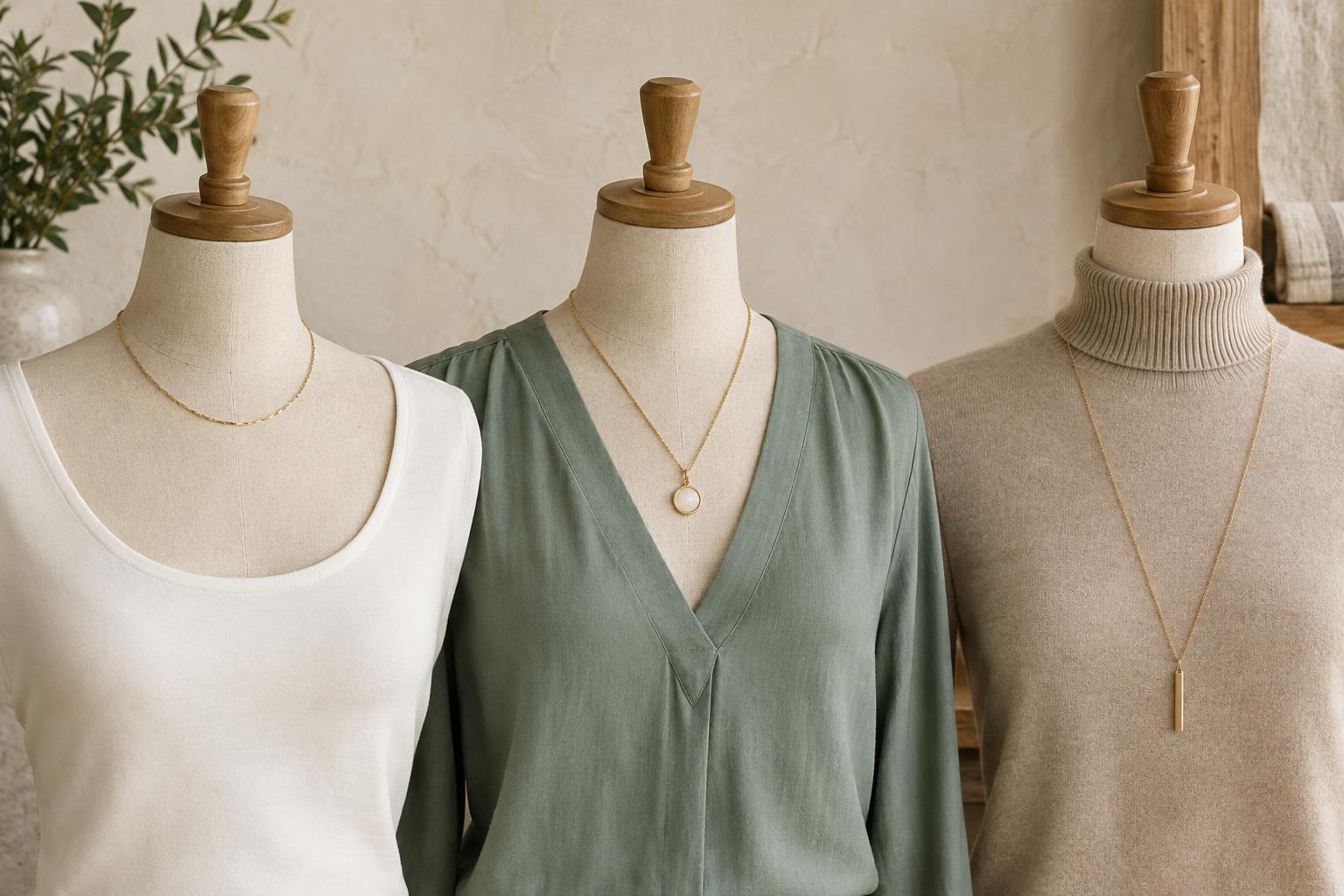
A V-neck already points downward, so a pendant that sits inside the V often echoes its shape. Leave a little space between the pendant and the bottom of the opening rather than trying to match the point precisely. A delicate short chain can also sit above a deeper V, creating a separate line. If the necklace crosses the sloping edges of the neckline, try a different length or a pendant with a different weight.
Scoop and round necklines offer more room to experiment. A shorter necklace can sit above a wide scoop, while a medium-length pendant can occupy the open area. With a shallow scoop or crew neck, decide whether the jewelry should be clearly above the fabric edge or comfortably below it. A chain that repeatedly disappears under the collar is usually less convenient than either choice.
Square necklines have strong corners and a straight upper edge. A small pendant centered within the opening adds contrast without competing with that structure. A shorter curved necklace can follow the space above the edge. For a boat neck, which leaves little room at the center but opens toward the shoulders, consider a longer pendant over the fabric or skip a necklace and let earrings do the work.
Let collars and high necks guide the choice
A buttoned shirt changes shape depending on how many buttons are open. With a small opening, a short chain or modest pendant can sit inside the collar without tangling with it. With a wider opening, you have room for a longer drop. Check the necklace with the shirt tucked, untucked, and in motion; collars can shift more than a fixed neckline.
For a turtleneck or other high neck, jewelry usually works best when it sits visibly on top of the fabric. A longer chain provides a clean vertical line, while a shorter statement necklace can bring detail close to the face. Consider the texture beneath it: a fine chain may get lost against a chunky knit, and a heavy pendant may pull a lightweight top out of shape. Smooth, substantial pieces are often easier to see against textured fabric.
Balance the pendant, not just the chain
Two necklaces of the same length can behave differently. A small charm may rest neatly above a neckline, while a larger pendant at the same point can overlap its edge. A wide pendant needs enough open space around it to read clearly; a narrow one can suit a tighter V or the space between shirt lapels. If you are shopping for a pendant and chain separately, test them together rather than choosing the chain by length alone.
Layering works best when each piece has a visible place. Start with one necklace that suits the neckline, then add another that ends noticeably higher or lower. Slight differences in length can make chains bunch together, particularly if their pendants are similar in size. Adjustable chains or a removable extender make it easier to refine the spacing across several tops.
Make comfort part of the final check
A good pairing should be easy to wear through an ordinary day. Sit down, lean forward, and turn your head. Notice whether the clasp creeps toward the front, the pendant hits a button, or the chain catches on hair or fabric. If it does, a small length adjustment may solve more than changing the outfit.
When building a small necklace collection, choose pieces for the necklines you wear most often rather than trying to cover every possible combination. One shorter adjustable chain, one pendant that sits within your usual open neckline, and one longer piece for wearing over clothing can offer useful variety. Treat styling guidelines as options: the best length is the one that looks intentional to you and stays comfortable where you want it.