Start with the finger and the ring you plan to wear
Ring size belongs to a particular finger on a particular hand. Your corresponding fingers may not measure the same, so measure the finger that will wear the ring rather than assuming a size from another hand. If you plan to stack rings, consider the combined width of the stack as well as each band on its own.
Timing matters, too. Fingers can feel different after activity, in heat or cold, and at different points in the day. Measure more than once under ordinary conditions, when your hands feel comfortable rather than unusually warm or cold. If the results vary, treat that variation as useful information: you need a fit that works through normal changes, not just for one measurement.
Measure an existing ring or use a ring sizer
If you already own a ring that fits the intended finger well, measure its inside diameter across the widest point of the opening. Place it on a flat surface and use a ruler with millimeter markings, taking care to measure the empty space inside the band rather than its outer edges. Compare that measurement with the size chart supplied by the seller. Sizing systems vary by region, so confirm which system the chart uses before ordering.
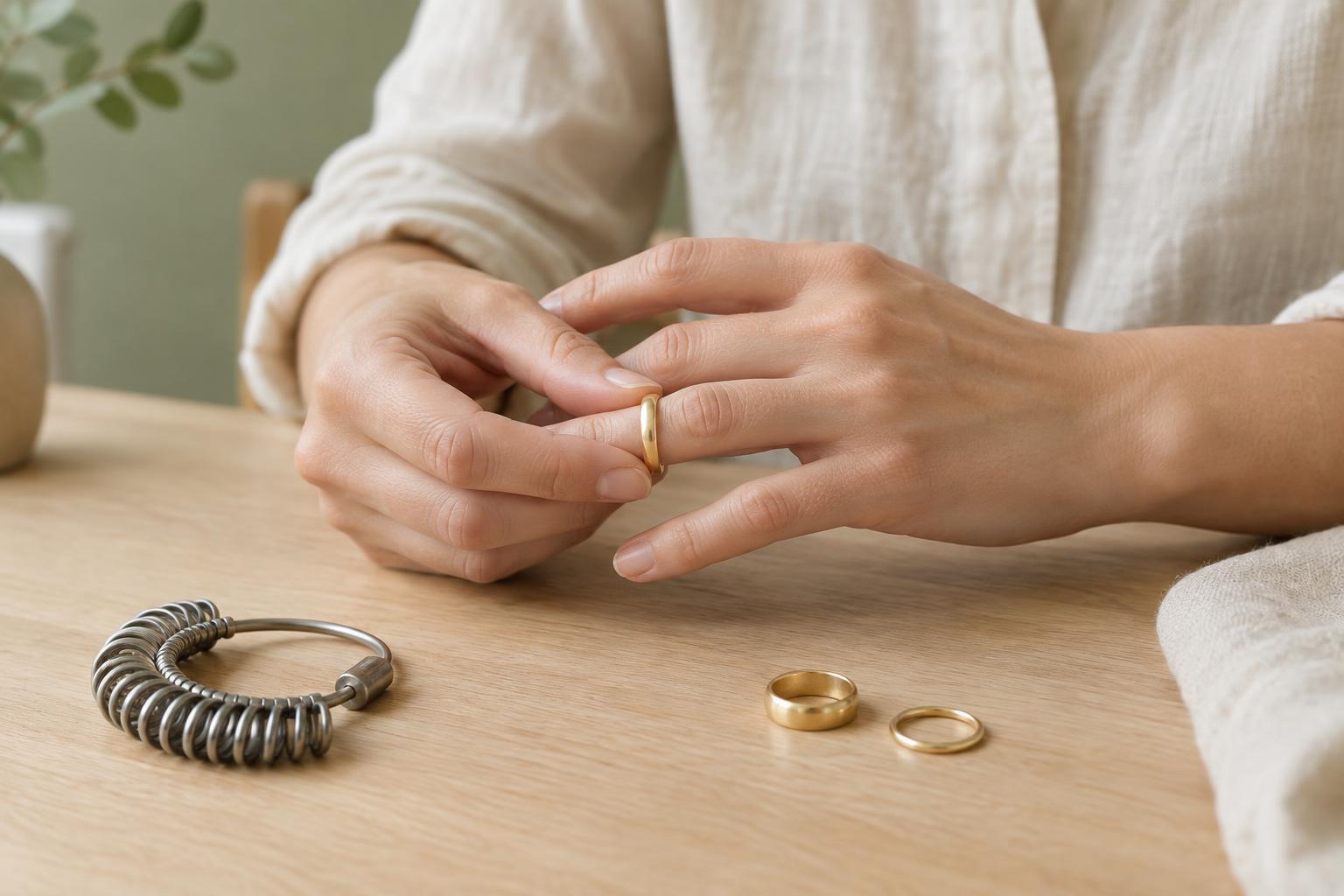
A ring sizer is another useful option, particularly when you can try several sizes in succession. Slide each size over the knuckle and let it settle at the base of the finger. If you use a flexible strip at home, keep it flat and comfortably snug, mark where it meets, and measure its length. Avoid stretching it or pulling it tight enough to compress the skin. String is less reliable because it can stretch or twist. For an expensive or hard-to-return ring, an in-person measurement is a sensible extra check.
Check the fit by moving, not just looking
A well-fitting ring should pass over the knuckle without a struggle and sit comfortably at the base of the finger. Try turning it gently, making a fist, and letting your hand hang at your side. The ring may rotate a little, especially if it has a heavy setting, but it should not feel ready to slide off during normal movement. It should also come off with a deliberate twist rather than forceful pulling.
Pay attention to what happens after several minutes of wear. A band that leaves a light impression is not necessarily too small, but pinching, persistent discomfort or a feeling that you cannot remove it easily are reasons to try a larger size. If it slips past the knuckle with almost no resistance or shifts constantly, try a smaller one. The goal is secure comfort, not a ring that stays perfectly still.
Allow for band width and ring design
Two rings marked with the same size can feel different. A wide band covers more of the finger and may feel tighter than a narrow one; a stack can have a similar effect. If possible, try a sizer or sample band close to the width of the ring you want. Do not automatically size up by a fixed amount, since the best adjustment depends on the design and your finger.
The inside shape also affects how a ring slides over the knuckle. Some bands have a rounded interior, often called a comfort fit, while others have a flatter inside surface. Large stones or top-heavy settings may turn even when the band itself fits. If rotation is your main concern, ask the seller about the ring’s design and available adjustments rather than choosing a tight size to hold the setting in place.
Make a final check before you buy
Look at the seller’s size chart, measurement instructions, return policy and resizing options together. Some designs are difficult to resize, including certain patterned bands and rings with stones set around the entire circumference. If you are between sizes, those details may matter more than a generic rule about rounding up or down.
For a gift, a ring worn on the intended finger can provide a starting measurement, but only if you know it fits that finger now. Otherwise, an adjustable design or an easy exchange may be less risky than a guess. When your measurements disagree, repeat them calmly and prioritize a real-world try-on where possible. A number helps you shop; the final test is whether the ring feels comfortable, secure and easy to live with.