Start with the routine, not the capacity label
Before choosing a bin, notice what goes into it and how often you want to empty it. A bathroom bin that holds tissues and packaging has a different job from a kitchen bin that receives food scraps. If you already use a bin, its full liner offers a useful reference: do you empty it because it is full, because it smells, or simply because it is collection day? A larger bin helps only with the first of those problems.
Think about the people and habits sharing the space, too. Someone who cooks most evenings may want a kitchen bin that is easy to reach while preparing food. A household that separates recycling may need several modest containers rather than one large bin. Choose enough capacity for an ordinary stretch between emptying, with some room to tie the bag, but avoid buying so much capacity that waste sits longer than you would like.
Measure the space the bin actually uses
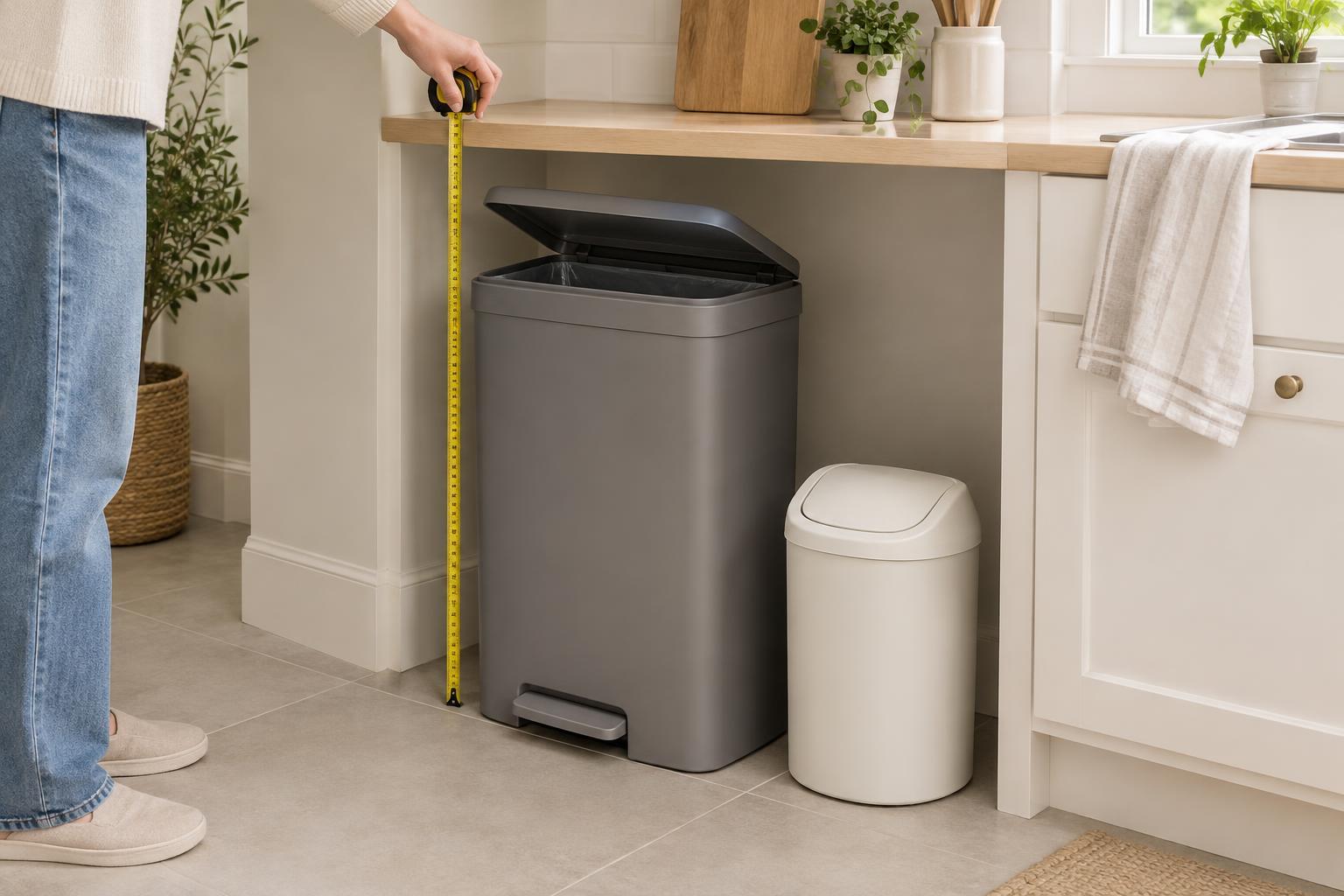
Capacity tells you how much a bin can hold; it does not tell you whether it will fit comfortably. Measure the available floor area, then check the bin’s width and depth, including any pedal or projecting handles. Leave space to remove the liner without scraping a wall or cabinet. A narrow rectangular bin can make good use of a gap beside a counter, while a round one may be easier to move around in an open corner.
Also measure above the bin. A hinged lid needs room to lift fully, which matters under a countertop or shelf. A pull-out bin needs a clear path for the drawer or cabinet door. If the bin will live inside a cabinet, check the opening as well as the interior dimensions: a container that fits inside may still be awkward to lift out.
Use liner size as a final check rather than choosing by nominal bin volume alone. Bin shapes vary, and a bag that is wide enough may still be too short to fold over the rim. If possible, check the manufacturer’s suggested liner dimensions and whether the rim holds a bag securely.
Choose a lid for the way your hands are occupied
A step-on lid is useful in a kitchen because it opens without touching the top. Try to find out whether the pedal feels stable and whether the lid stays open long enough to change the bag. The pedal needs clear floor space in front, so it may be inconvenient in a tight passage. A simple lift-off lid has fewer moving parts and can suit a low-use room, though it usually takes two hands to manage waste and the lid separately.
Swing lids are quick for small, dry items, but a full bag or bulky packaging can obstruct the opening. Touch lids look tidy when closed, yet they require contact and their catches need occasional cleaning. Sensor lids offer hands-free opening without a pedal, but they need power and may open when someone passes close by. Whatever the mechanism, check that its opening is large enough for the things you regularly discard.
A lid can help contain the sight and some odors of waste, but it does not replace timely emptying and cleaning. For food scraps, a smaller, accessible container that you empty often may be more pleasant than a large covered bin. If you separate compostable material, follow the rules of the collection service or system you actually use.
Make emptying and cleaning part of the decision
The least noticeable bin is often the one that is easy to maintain. Look inside before buying: can you lift out an inner bucket, reach the bottom, and wipe around the lid hinge? Smooth surfaces and a removable insert simplify cleanup after a leaking bag. A bag-retaining ring can keep the liner from slipping, but check that it is straightforward to release when the bag is full.
Placement matters as much as the mechanism. Put a kitchen bin close enough to the work area to use naturally, without blocking a drawer or becoming a trip hazard. In a bathroom, a compact bin can sit near the sink or toilet while leaving room to clean the floor. In either space, test the whole sequence: open the lid, drop something in, remove the bag, and carry it out. If any step feels cramped, a different shape or lid may serve you better.
A simple way to make the final choice
Narrow the options in this order: decide what the bin will collect, choose an emptying rhythm, measure its location, and then compare lids. This keeps a good-looking finish from distracting you from a pedal you cannot reach or a lid that hits the counter. If two bins meet the practical requirements, choose the one whose surface and shape you will be happy to see every day.
There is no ideal capacity or lid for every home. A useful bin holds a manageable amount, opens easily where it stands, and makes changing the liner uncomplicated. Getting those details right is what turns a basic household object into one that quietly supports the routine around it.