Start with your day, not the display
Everyday earrings have a different job from occasion jewelry. They may need to stay comfortable through a commute, a video call, a walk, and an evening on the sofa. Before choosing a style, notice what usually makes you take earrings off: pressure from a backing, a hoop catching in your hair, a drop brushing your collar, or simply the feeling of weight. Those small annoyances are useful shopping criteria.
Think about the other things you wear near your ears. Glasses, headphones, scarves, high collars, and long hair can all change how an earring feels. A pair that works beautifully with an open neckline might be distracting with a chunky knit. If you want one dependable pair, choose it for your most common outfit and routine rather than the occasional look you hope to wear.
How studs, hoops, and drops feel
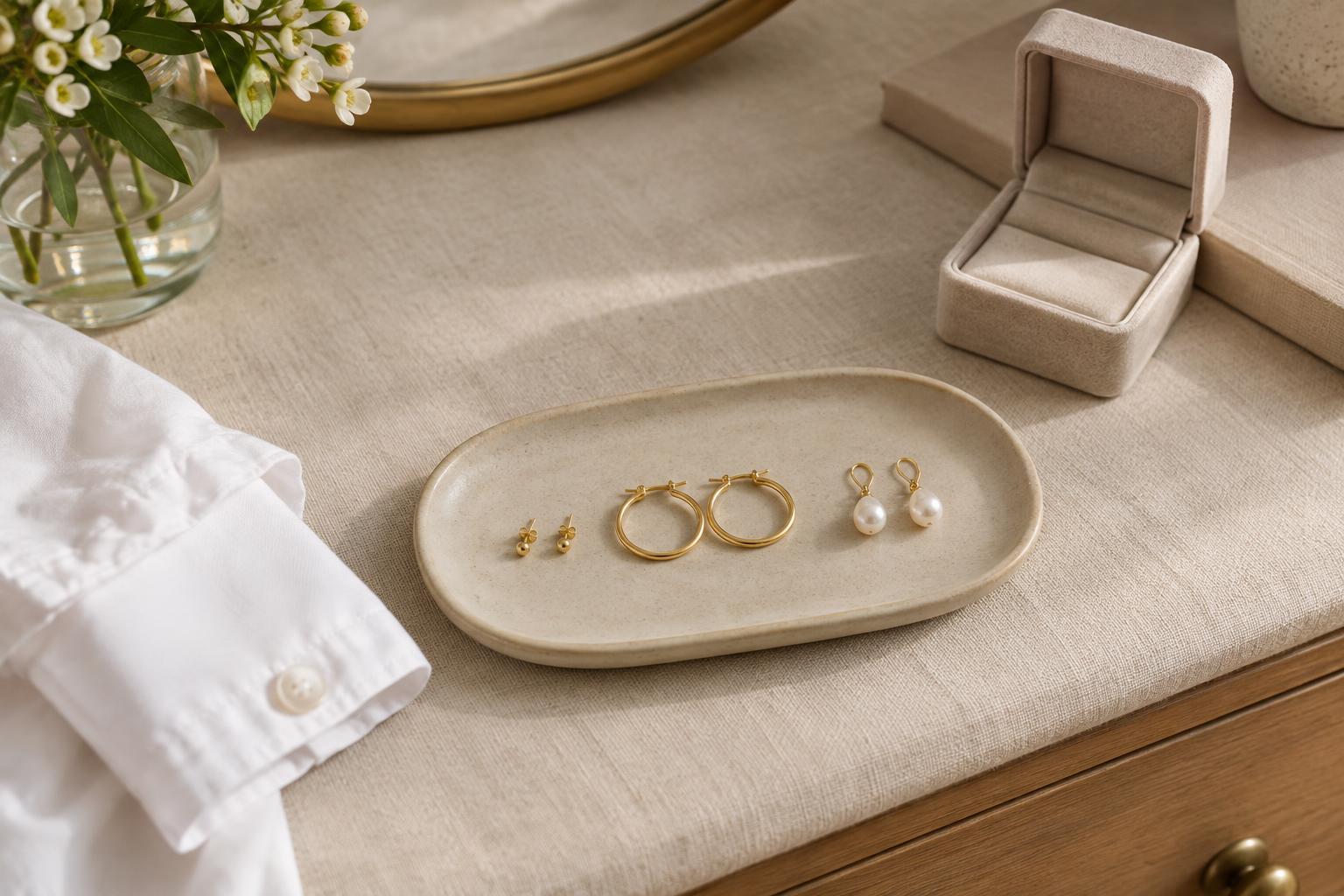
Studs sit close to the ear, so they are often the easiest place to begin. A small, smooth design is less likely to tangle with hair or clothing than one with sharp points or raised details. Check the post length and backing as well as the front: a backing that presses against the ear, or a post that pokes when you lean back, can make even a tiny stud uncomfortable. If you often rest your head against a chair, try the pair while doing just that.
Hoops offer a simple outline without needing a large decorative front. Their diameter matters, but so does their profile. A narrow, lightweight hoop may feel easier to wear than a thick one of the same size. Look at how the clasp closes and whether there is an exposed end that could snag. Drops bring movement and can brighten a plain outfit, but they deserve a gentle sway test. If they swing into your neck, catch on a collar, or pull downward when you move, consider a shorter or lighter version.
Pay attention to weight, materials, and closures
An earring’s appearance does not always reveal its weight. A broad shape can be light if it is hollow or made from a lighter material, while a compact design can feel surprisingly substantial. When trying on a pair, move your head and wear it long enough to notice whether you keep thinking about it. For everyday use, the best weight is one you can comfortably forget. If you are shopping online, look for clear dimensions and weight information; if either is missing, it is harder to judge fit.
Materials are personal, too. If certain earrings have bothered your ears before, note what they were made from and look for clearly stated materials, especially for posts and hooks. Vague labels such as “metal” offer little help. Closures deserve the same attention: butterfly backs are familiar and easy to replace, screw backs may feel more secure to some wearers, and hinged hoops can be convenient when their clasps align cleanly. Whatever the style, it should fasten without a struggle and stay closed during ordinary movement.
Build a small rotation that earns its space
You do not need many pairs to cover everyday situations. A close-fitting stud, a modest hoop, and a short drop can each play a distinct role without demanding a separate outfit. Choose finishes that work with the colors and accessories you already wear, rather than trying to match every item exactly. One quiet pair might suit busy mornings; another can add a little movement when your clothes are simple. Repeating favorites is a sign that they work, not a failure to vary your look.
Keep the pairs you wear often easy to find, with backs and clasps together. Wipe away everyday residue gently using a method appropriate to the material, and store earrings so they do not rub against harder pieces or become tangled. Before putting a pair on, give the closure a quick check. The strongest test of an everyday earring is simple: it fits into your routine, stays where it should, and lets you get on with your day.