Start with the space and the daily load
An entryway needs to handle the things people bring home without making the trip through the door awkward. Before choosing a fixture, note where the door swings, how much clear walking space remains, and whether coats would brush against a wall, mirror, or light switch. Then count what needs a regular home: everyday jackets, bags, hats, scarves, and perhaps a guest coat or two. Designing for that ordinary load is more useful than imagining a perfectly empty hallway.
Consider how people actually put things away. A hook makes it easy to hang a jacket with one hand; a rail with hangers keeps coats straighter but asks for an extra step. If several people arrive at once, storage spread across a wall may work better than one crowded spot. Leave some breathing room between items so the entryway feels usable even when everything is occupied.
Choose wall hooks for flexible, compact storage
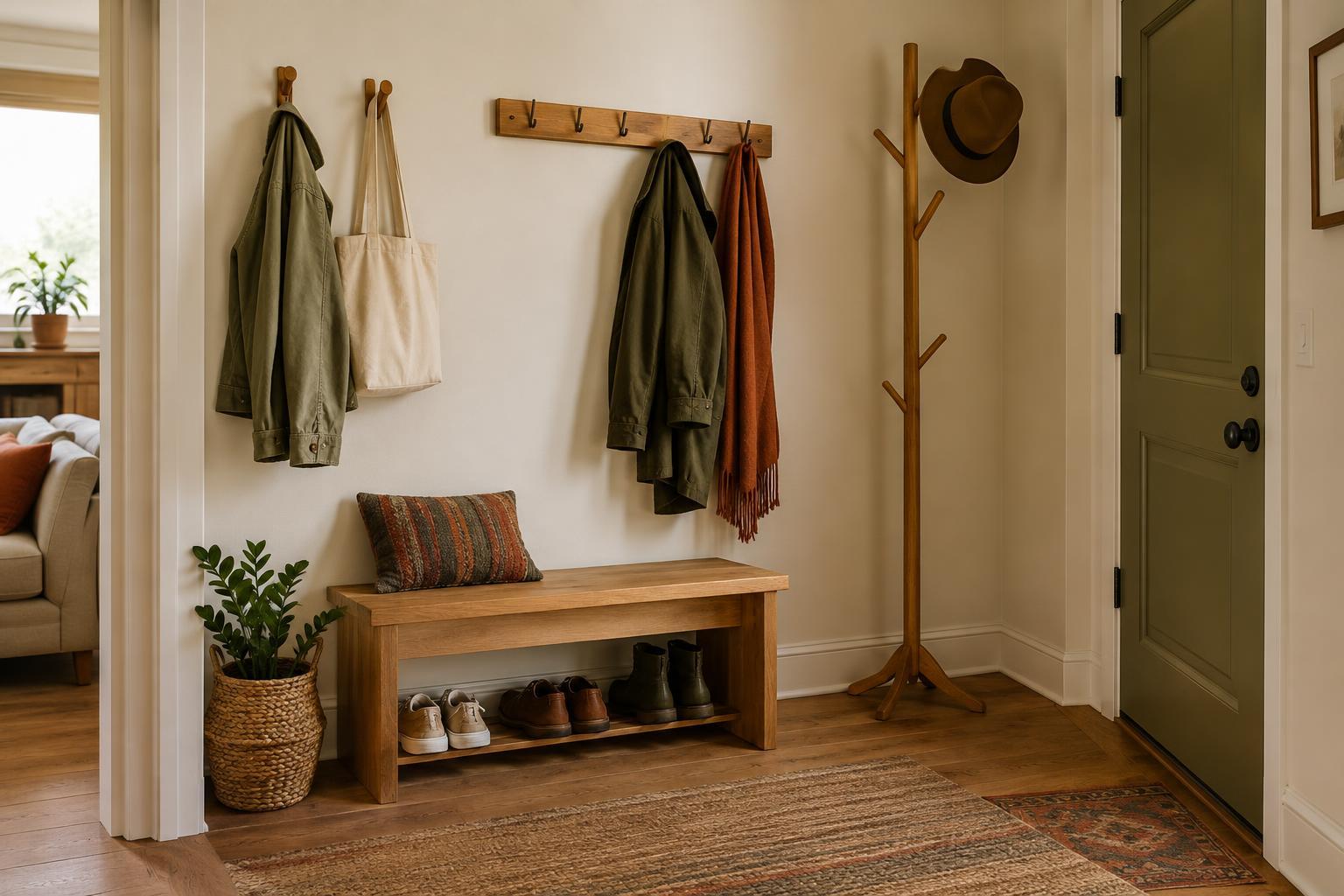
Individual wall hooks suit narrow entries because they use little floor space and can be placed around obstacles. They also let you vary the height: a lower hook can serve a child or hold a frequently used bag, while higher hooks keep longer coats off the floor. Hooks with a broad, smooth contact point are generally kinder to clothing and bag straps than sharp or very small pegs.
Their main drawback is visual clutter. A row of uncovered jackets can look busy, and coats piled on one hook may be difficult to grab. Plan for more hanging points than the number of coats you normally use, rather than asking each hook to carry several bulky items. Check each product’s stated load limit and use fixings suited to your wall; a good hook is only as dependable as its installation.
Use a hook rail or hanging rail for an orderly line
A hook rail combines several hooks on one backing board, creating a clear storage zone without measuring the spacing of every hook separately. It can make a small wall look more intentional, especially when the finish relates to nearby door hardware or a bench. Look at the spacing between hooks before buying: closely packed hooks may be fine for keys and light layers but frustrating for thick winter coats.
A hanging rail uses hangers instead of hooks and is worth considering when keeping coats relatively smooth matters more than quick drop-off. It needs room for hanger width and for coats to project into the entryway, so measure the full depth of a hanging coat, not just the rail. In a tight passage, a hook rail often preserves more usable space. Either option should be mounted according to its instructions, with wall fixings appropriate for the expected load.
Pick a freestanding coat rack when walls are off-limits
A freestanding rack avoids drilling and can move when the layout changes. It works best where there is a spare corner or a generous patch of floor near the door. If you rent or prefer not to alter a wall, it may be a simpler starting point than permanent storage. A rack can also hold occasional guest coats while the household’s daily items live elsewhere.
Stability matters more than a slim silhouette. Check the footprint, base weight, assembly, and how the rack behaves when heavier items hang on one side. Bags and long coats can shift its balance or spread beyond its base. In a busy or very narrow entryway, even a compact rack may become something to walk around; mark its footprint on the floor before deciding it fits.
Make the choice work as a small system
The best answer may combine two kinds of storage. A few easy-reach hooks can take daily jackets and bags, while a rack or rail handles less-used outerwear. Keep keys and other small essentials on a nearby tray or shelf instead of loading every hook with miscellaneous items. If damp coats are common, allow enough spacing for them to air out rather than compressing them into a tight row.
Before buying, compare four things: the space the storage occupies when full, the weight it needs to hold, the wall or floor conditions, and how quickly people can use it. Choose wall hooks for adaptable placement, a hook rail for a neat everyday drop zone, a hanging rail for coats kept on hangers, or a freestanding rack for flexibility. The right choice is the one that still makes the doorway easy to use on a busy day.