Start with what the clip needs to hold
A hair clip works by keeping a section of hair under gentle pressure. If the section is too thick, the clip may spring open or sit at an awkward angle. If it is too thin, the clip may close fully without gripping much at all. Before deciding that a clip is faulty, notice whether it slips from a small side section, a half-up style or a full twist. Each asks something different of the same accessory.
Length and density matter, but so does how you gather the hair. A loose twist can create more bulk than a tightly gathered one, while layers can leave shorter pieces outside the clip. Try holding your intended style with one hand before fastening it. The amount you can gather comfortably gives you a better starting point for choosing a clip than the clip’s overall length alone.
Match the mechanism to the job
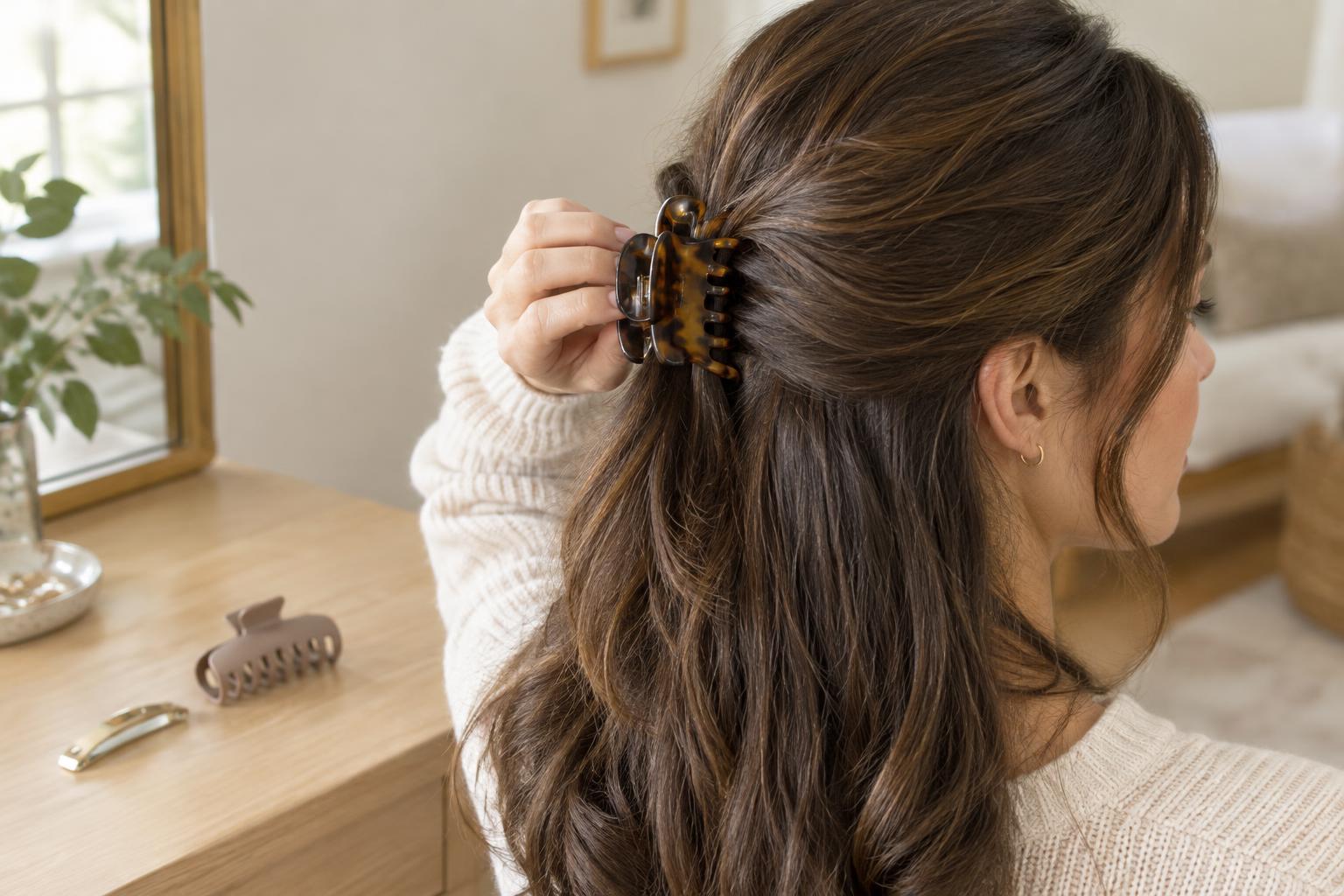
Claw clips are useful for twists and larger sections because their teeth reach around the hair. Look at the space between the jaws when the clip is open, as well as how the teeth meet when it closes. A large claw with widely spaced teeth may feel secure around a substantial twist but slide through a small section. A smaller claw with closer teeth may suit a half-up style better, even if your hair is long.
Barrettes and snap clips serve different purposes. A barrette usually holds hair between a curved top and a fastening piece; one that barely shuts over your hair is likely too small for that section. A snap clip lies flatter and works well for pinning back lighter sections near the face, but may not be the best tool for the weight of a full updo. If you want one accessory for several styles, expect to change the amount of hair you gather rather than asking it to grip every section equally well.
Consider texture and surface
Very smooth hair can move through polished plastic or metal, especially when freshly brushed. Textured or curly hair may offer more friction, yet a clip can still slip if its teeth only catch the outer layer of a bulky section. Neither situation means you need the strongest possible spring. Too much pressure can make a clip uncomfortable without fixing a poor match between its shape and your style.
For finer or slippery hair, try a clip with closer-set teeth or a less slick interior surface. A small barrette with a secure fastening may also work better for a modest section than an oversized claw. For thick or dense hair, prioritize enough room for the gathered hair and teeth long enough to reach around it. Check that the hinge opens smoothly and that the clip closes without forcing it; a comfortable fit is easier to wear for a full day.
Adjust placement before buying another clip
Even a well-sized clip can slide when it is attached to the end of a loose twist. To anchor a claw clip, gather the hair, twist it gently upward and place the teeth where the twist meets the hair close to your head. The clip should catch some hair at that base rather than only the free ends. If it feels as though it is pulling, loosen the style or reposition the clip instead of clamping harder.
For a half-up style, take sections from both sides and fasten them where they overlap. If the clip closes with empty space, gather a little more hair or switch to a smaller clip. If it strains, use less hair. Small adjustments often tell you whether the problem is sizing, placement or a clip whose fastening no longer holds reliably.
Use a quick fit test when shopping
Think of the hairstyle you wear most, then look past the clip’s color and silhouette. Is the opening deep enough for your usual twist? Do the teeth meet in a way that can catch a smaller section? Does the fastening close cleanly, without sharp edges where hair could snag? If you can try the clip, move your head gently after fastening it. A clip that feels secure only while you stand still may not suit an everyday routine.
It can be more useful to keep two well-matched clips than one oversized all-purpose option: perhaps a smaller clip for face-framing pieces and a roomier claw for a twist. When a clip slips, first change the section size or its placement. If neither helps, choose a different shape or grip for that particular style. The goal is not to hold your hair as tightly as possible, but to find a clip that stays put without demanding attention.